
AutoNaut
Background
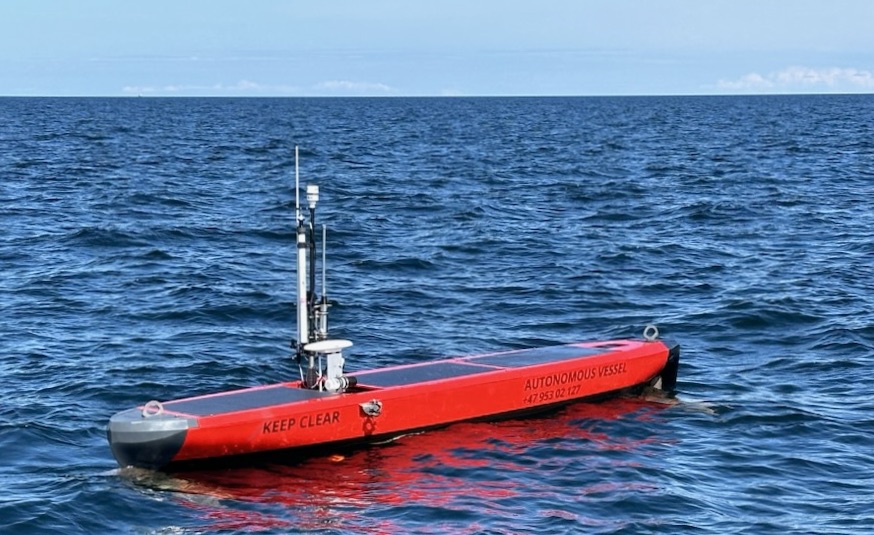
AutoNaut is a self-powered unnmanned surface vehicle (USV) designed to be a cost effective, low man-power data collection platform, with zero emission, extreme persistence and capability of surviving extreme weather conditions. Zero emission is achieved solely by wave and solar power. A patented Wave-propulsion Technology converts energy from the pitch and roll of the waves. AutoNaut is equipped with spring-loaded foils attached to the struts under the keel. These foils exploit the wave-induced vessel motion, caused by waves lifting the vessel up, out of the water and dropping it down again, to generate the forward propulsion. Under very calm weather conditions when the waves cannot alone propel the USV, an electrical thruster on the stern strut can be used. This USV is the 5-meter version with max speed up to 3 knots, depending on the sea state.
The AutoNaut with its various scientific sensors operates on real missions: calibrating images from the HYPSO hyperspectral satellites, detecting algae blooms, and collecting water samples capable (can detect the DNA of a fish that swam by! 🤯). Students working on this project may participate in sea trials along the Norwegian coast. This is not a (pure) simulation project: the software you develop will run on a real vehicle in real conditions.
Scope
There are various challenges with the AutoNaut that requires attention, so it is possible to steer this project in different directions:
- Mission planning and execution: plan where the AutoNaut should go, based on scientific objectives, and how to get there in a safe and efficient manner under the predicted environmental forces and the situation in general. During plan execution, the AutoNaut considers risks, including collision avoidance, anti-grounding. This builds on existing and ongoing work on guidance and control, speed prediction (what speed can the AutoNaut obtain for a given heading under some current/wind/wave condition?), collision avoidance and anti-grounding.
- Data pipeline: the data from the scientific sensors on the AutoNaut are used both in real-time decision-making and in post-process analysis. For decision-making (such as determining where to deploy other vehicles), the data must be transferred from the AutoNaut, which requires both energy and connectivity. How can we minimize energy use and still transfer the necessary data? How can we adjust the data rate to the quality of the data link? In the past we have relied on 4G (cheap, fast, but limited coverage) and iridium (expensive, slow, but global coverage), but we have recently also installed Starlink, which is fast with great coverage, but draws a lot of power. For post-process analysis, the denser data from the onboard binary log is parsed and distributed to various log analysis (e.g. grafana) and storage solutions, possibly combined with data from other sources (satellites, other vehicles, online services), to produce high-quality “data products”. We would also like to share the data through online data services, such as EMODnet
What You Will Learn
Mission planning direction: Autonomous mission planning and replanning under uncertainty, risk-based decision-making, maritime collision avoidance regulations (COLREGs), and field experience with a real marine robot.
Data pipeline direction: Design of resilient data pipelines for resource-constrained platforms, communication protocol trade-offs (4G/Iridium/Starlink), real-time and post-process data workflows, and integration with open marine data standards.
Contact
Contact supervisors Kristoffer Gryte and Tor Arne Johansen